
Battery Storage for SMEs: Is the Business Case There Yet?
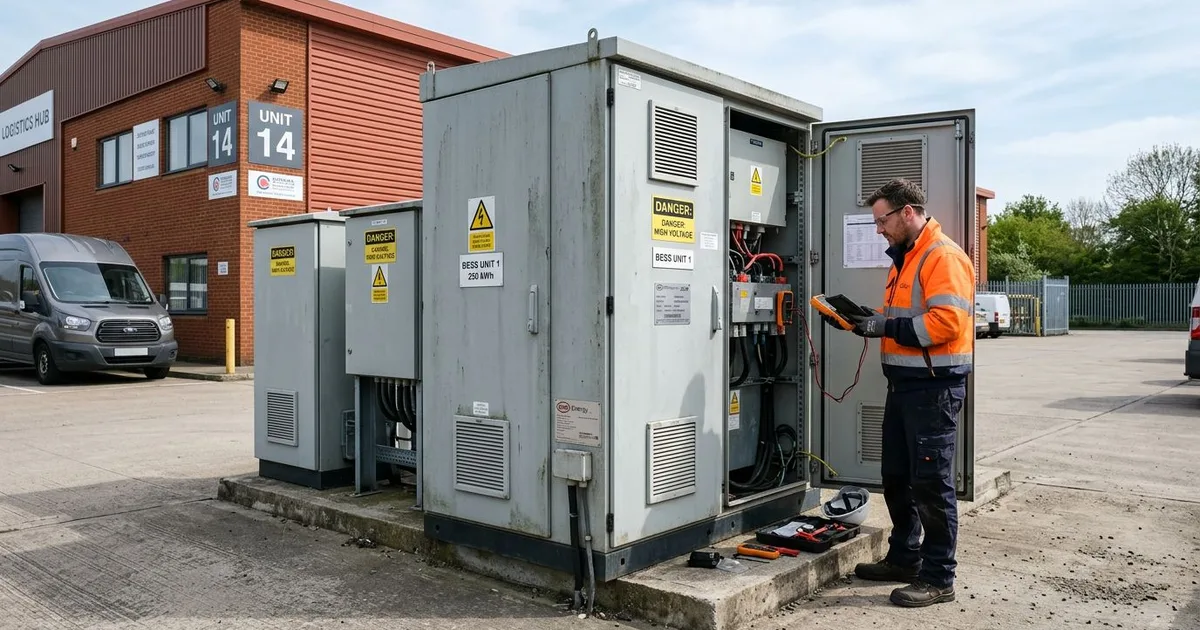
Commercial Battery Storage Costs £80,000–£250,000 Installed. At Current UK Electricity Prices, Most SME Sites Can’t Make the Numbers Work. Here’s Why — and When They Can.
Battery storage has been one of the most discussed energy technologies in the UK market for the past five years. The narrative is compelling: store cheap overnight electricity, use it during expensive peak periods, reduce grid demand charges, and potentially participate in demand-side response programmes. The technology is proven — lithium-ion battery storage is deployed at scale globally and operates reliably in commercial settings.
The business case for SME-scale commercial battery storage in the UK in 2026 is, in most cases, marginal or negative. Not because the technology doesn’t work — it does — but because the financial returns available from the UK commercial storage market don’t yet justify the capital cost at most site scales. Understanding why, and knowing the specific conditions under which it does work, is more useful than either uncritical enthusiasm or blanket dismissal.
What Battery Storage Can and Cannot Do
Commercial battery storage operates across three potential revenue or saving streams:
1. Time-shifting (peak shifting): Charge the battery during low-cost periods (typically overnight, when wholesale electricity prices are lower), discharge during high-cost periods (afternoon peak, when grid electricity is most expensive). The saving is the difference between the charge cost and the avoided discharge cost.
For this to generate meaningful returns, the business must be on a time-of-use tariff with a significant day-night price differential. On a standard flat-rate fixed contract, peak shifting generates no saving — the electricity costs the same at all times.
2. Demand charge reduction: Battery storage can reduce the peak kW demand recorded on a site’s meter during Triad periods or during DUoS red band periods, reducing the demand-based charges described in our network charges article. This is sometimes the most financially significant application for UK commercial sites on half-hourly metering with high peak demand.
3. Grid services revenue: Batteries registered with grid service providers can earn revenue from demand-side response programmes — being paid to reduce consumption or increase it on command from the grid operator (NESO). This revenue stream is most accessible and most valuable for larger storage assets (typically 500 kWh+) operating in aggregated DSR schemes.
The UK Commercial Storage Business Case in 2026
The financial challenge for SME-scale commercial storage comes down to capital cost versus available revenue streams:
Capital cost: A commercial lithium-ion battery system suitable for a UK SME premises — 100–250 kWh capacity with appropriate inverter and BMS — currently costs approximately £80,000–£200,000 installed, including grid connection work if required. Larger systems (500 kWh+) scale to £300,000–£600,000.
Revenue stream 1 — time-shifting: To generate meaningful returns from time-shifting, the business needs to be on a half-hourly settled time-of-use tariff with a realistic day-night differential. In the UK commercial market, the available differential on most SME time-of-use products is currently 8–15p/kWh. A 100 kWh battery cycled once daily at a 10p/kWh differential generates: 100 kWh × £0.10 × 365 days × 90% efficiency = £3,285/year. At that return rate, payback on a £100,000 system is 30 years. The maths don’t work at current differentials for most SME-scale sites.
Revenue stream 2 — Triad avoidance: For a site on HH metering with significant Triad exposure, a battery discharging during Triad windows reduces the demand registered at those moments. A site with 200 kW of Triad-exposed demand, reducing to 50 kW during Triad events via battery discharge: saving approximately 150 kW × TNUoS Triad rate (currently ~£30–50/kW/year in high-demand zones) = £4,500–£7,500/year. More meaningful — but alone, still a 15–25 year payback on a commercial system.
Revenue stream 3 — DSR/FFR income: Batteries participating in Dynamic Containment (DC), Dynamic Regulation, or other frequency response services via grid service aggregators can earn £10,000–£40,000/year per MW of registered capacity. This is the most financially significant revenue stream for batteries in the UK — but it requires minimum size thresholds (typically 500 kWh+ to be viable as an aggregated participant), grid connection modification, and an aggregator relationship.
When the Business Case Does Work
Commercial battery storage makes financial sense in the UK in 2026 under specific conditions:
Large sites with grid-constrained connections: Some sites — particularly those with growing EV charging loads or production expansion plans — face DNO connection upgrade costs of £50,000–£200,000+ and 12–18 month wait times for reinforcement works. A battery system installed at lower cost than the grid upgrade, providing peak demand management to avoid the constraint, can have a payback measured in months against the avoided grid reinforcement cost.
Sites with co-located solar generation: A battery paired with an existing or planned solar installation allows excess solar generation to be stored for use during evening peaks rather than exported at low rates. This increases self-consumption and the effective financial return from the solar system. The combined solar + battery business case is often more compelling than battery alone, particularly as export rates have fallen.
Industrial or commercial sites with large HH-metered demand and active Triad management: At consumption scales of £200,000+/year on electricity, the combination of Triad avoidance, DUoS demand reduction, and DSR participation can generate returns that justify investment in 500 kWh+ systems with payback periods of 7–12 years.
Sites eligible for grant support: Various grant schemes — including LEVI (Local Electric Vehicle Infrastructure), the Industrial Energy Transformation Fund (IETF), and local enterprise partnership capital grants — have supported commercial battery storage investment. Eligibility varies by site type and application window. A system that doesn’t work commercially without grant support may work with it — particularly for manufacturing sites with energy efficiency investment requirements.
The Falling Cost Trajectory
Battery storage costs have fallen by approximately 90% over the past decade and continue to decline — driven by EV battery manufacturing scale economies and increasing competition between cell manufacturers. Current projections suggest commercial storage costs will continue to fall at 5–10% per year through the late 2020s.
For businesses evaluating storage today and finding the business case marginal, revisiting in 2–3 years at lower capital costs and potentially higher DSR revenue (as grid services markets develop) may produce a more compelling case. The technology is directionally correct; the timing of investment requires genuine financial analysis rather than enthusiasm for the concept.
Telnergy’s Assessment Framework
When clients ask us about battery storage, our starting point is always the financial model: consumption profile, current contract structure, Triad exposure, DSR revenue potential, available capital, and the grid connection situation. We don’t have a commercial interest in recommending storage — we don’t install it. Our interest is in whether the investment makes financial sense for the specific client. In most cases for SMEs spending under £150,000 per year on electricity, it currently doesn’t. In specific cases — grid-constrained sites, solar co-location, large HH demand sites — it can.
📱 WhatsApp Business: 07360 272168
📧 Email: hello@telnergy.com
📞 Direct line: 01202 028888
Telnergy Limited • Independent Energy Consultants since 2002 • Ofgem-Aligned Consultancy • Christchurch, Dorset
Telnergy Limited is an independent commercial energy consultancy established in 2002, based in Christchurch, Dorset. Ofgem-aligned consultancy · ADR Ref E3561 · CRN 04576876.