
Green Energy for Business UK: A Plain-English Guide for SMEs
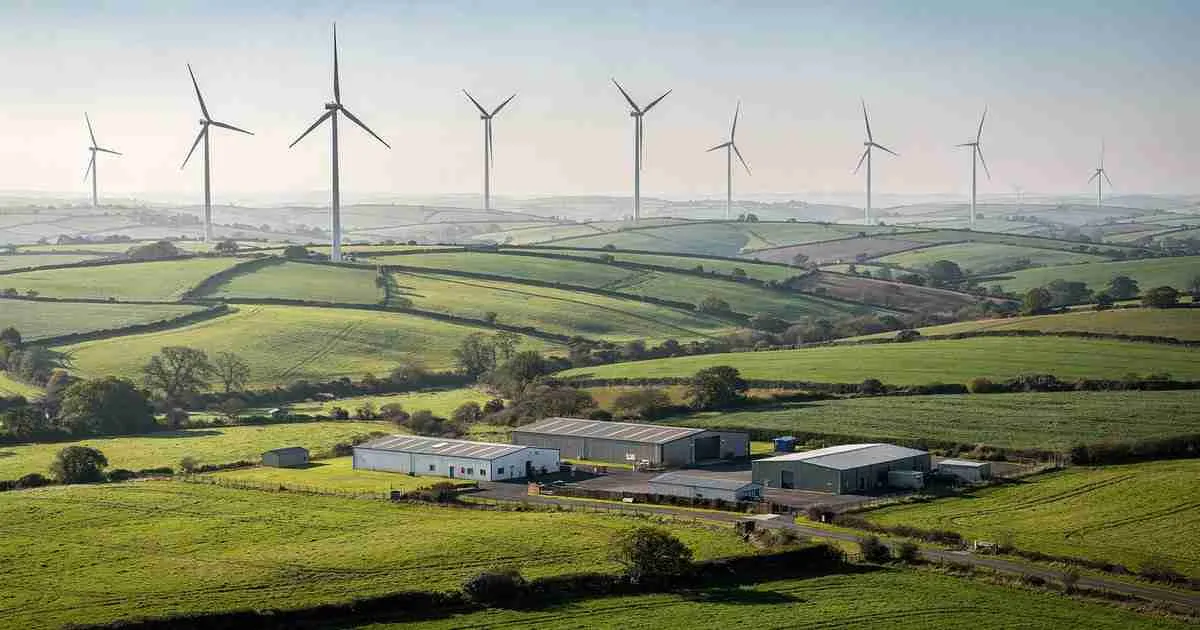
Green Energy for Business: A Plain-English Guide for UK SMEs
What are the green energy options for UK businesses in 2026?
UK businesses can access green energy through REGO-backed electricity tariffs (renewable energy certificates matched to your consumption), Power Purchase Agreements (PPAs, which source electricity directly from a named generator), or by switching to a supplier that offers a verified renewable product. In most cases, SMEs can now move to a green tariff at little or no premium over standard rates.
Why Green Business Energy Is No Longer a Premium Product
A few years ago, asking your energy supplier for a green tariff meant accepting a meaningful cost premium. In 2026, that is largely no longer the case for UK business electricity customers.
The rapid build-out of renewable generation capacity, wind, solar, and increasingly battery storage, has brought the wholesale cost of renewable electricity close to parity with the fossil fuel mix for much of the year. The UK generated a record 47% of its electricity from renewable sources in 2023, with that proportion continuing to rise.1 This structural shift in the generation mix has made green business electricity tariffs genuinely competitive.
For UK SMEs looking to reduce their carbon footprint, demonstrate environmental credentials to customers and supply chains, or begin working toward a net zero target, the business case for switching to green energy has never been clearer. The question is no longer whether to go green, it is how to do it cost-effectively and with confidence that the claims you make about your energy are backed by credible certification.
The Two Main Routes to Green Business Electricity
Route 1: REGO-Backed Tariffs
REGO stands for Renewable Energy Guarantees of Origin. It is the UK’s certification mechanism for confirming that a unit of electricity was generated from a renewable source. When a renewable generator produces electricity, it receives one REGO certificate per megawatt-hour (MWh) generated. Suppliers purchase these certificates and use them to “match” electricity sold to business customers as green.
When you sign a REGO-backed business electricity contract, your supplier is committing to holding enough REGO certificates to cover your entire annual consumption. The electricity physically flowing to your premises is the same grid electricity as always, REGOs are an accounting and certification mechanism, not a physical connection, but the certificates provide a verified paper trail demonstrating that an equivalent amount of renewable electricity was fed into the grid.
Pros of REGO-backed tariffs:
– Widely available from most major business energy suppliers
– Competitively priced, often at or near parity with standard contracts in current market conditions
– Simple to procure through the standard tendering process
– Provides a verifiable claim for sustainability reporting purposes
Cons of REGO-backed tariffs:
– REGOs can be purchased separately from the physical electricity, which means the connection between your consumption and a specific renewable generator is indirect
– Some sustainability frameworks, particularly those aligned with the Science Based Targets initiative (SBTi) or RE100, require a more direct link to generation and may not fully recognise REGO-only claims2
– Quality varies: cheap REGO certificates can be sourced from old, fully depreciated hydroelectric plant rather than new wind or solar capacity
Route 2: Power Purchase Agreements (PPAs)
A Power Purchase Agreement is a direct contract between your business and a renewable energy generator (or a supplier acting as intermediary with a named generator). Your electricity is sourced from a specific wind farm, solar park, or other facility, and the agreement locks in a price, typically for 5–15 years, for that electricity.
PPAs come in two forms for business customers:
Sleeved PPA (Physical PPA): The generator produces electricity, it flows through the grid to your premises, and the financial settlement is made directly between you and the generator (usually with a licensed supplier acting as the “sleeve” to handle grid balancing). This is the most direct form of renewable procurement and is most readily accepted by all corporate sustainability frameworks.
Virtual PPA (Financial PPA): You continue to buy electricity from a standard supplier at market rates. Separately, you enter a financial contract with a generator under which you pay a fixed “strike price” per MWh. If the market price is above the strike price, the generator pays you the difference; if below, you pay the generator. The net effect is a stable, hedged cost and a direct financial relationship with a named renewable generator, but no physical electricity flows between you.
Pros of PPAs:
– Strongest sustainability credentials, widely accepted by all major corporate reporting frameworks
– Sleeved PPAs can provide 100% traceable, additionality-positive renewable electricity
– Long-term price certainty, which is valuable for businesses with predictable energy needs
– Virtual PPAs provide price hedging without operational complexity
Cons of PPAs:
– Typically require a minimum annual consumption (commonly 1–5 GWh per year) that many SMEs do not reach individually
– Long contract terms carry volume commitment risk
– More complex to structure and procure than standard tariff switching
– Smaller SMEs are unlikely to access corporate PPAs directly without aggregation
For most UK SMEs, a REGO-backed tariff procured through a specialist consultant is the practical starting point. Businesses with higher consumption, particularly multi-site operators with aggregated demand, may be able to access PPA structures through a consultant’s supplier panel.
Green Gas: What Are the Options?
The green electricity picture is relatively straightforward. Green gas is more nuanced.
Biomethane and Green Gas Tariffs
A small but growing proportion of the UK gas grid carries biomethane, gas produced from organic waste (food waste, sewage sludge, agricultural residues) through anaerobic digestion. Like REGOs for electricity, green gas tariffs use certificates (Renewable Gas Guarantees of Origin, or RGGOs) to match your gas consumption to injections of biomethane into the network.
In 2024, biomethane accounted for roughly 5–6% of UK gas grid throughput, a figure that is growing but still modest.3 As a result, green gas tariffs typically carry a small premium over standard gas contracts, though the spread has narrowed as production capacity has expanded.
Heat Pumps and Electrification
For businesses with significant space heating loads, the most structurally sound route to decarbonising heat is electrification, replacing gas-fired boilers with heat pumps. This removes gas consumption entirely and means that decarbonising the electricity supply decarbonises heating simultaneously. The government’s Heat and Buildings Strategy sets out the policy direction for business heat decarbonisation.4
This is a capital investment decision rather than a tariff decision, but it is worth factoring into a medium-term energy strategy, particularly for businesses with long-term leases or owned premises.
Green Energy and Net Zero: Understanding the Difference
Switching to a REGO-backed electricity tariff reduces your Scope 2 carbon emissions (emissions from purchased energy) to near zero for accounting purposes. That is meaningful, Scope 2 emissions represent a significant share of many businesses’ total carbon footprint.
But net zero is a broader commitment. The Greenhouse Gas Protocol, which underpins most corporate net zero frameworks, distinguishes between three scopes of emissions:5
- Scope 1: Direct emissions from sources you own or control (gas boilers, company vehicles, manufacturing processes)
- Scope 2: Indirect emissions from purchased electricity and heat
- Scope 3: All other indirect emissions, supply chain, business travel, employee commuting, product lifecycle
A green electricity tariff addresses Scope 2. Achieving genuine net zero requires action across all three scopes, which typically involves a combination of energy efficiency improvements, supply chain engagement, electrification of heat and transport, and, where residual emissions cannot be eliminated, credible carbon offsetting.
For SMEs at the start of their net zero journey, the practical sequence is:
- Understand your current emissions baseline (a carbon audit)
- Switch to a green electricity tariff to address Scope 2
- Implement energy efficiency measures to reduce absolute consumption across all scopes
- Develop a roadmap for Scope 1 reduction (typically heat and transport)
- Address material Scope 3 sources as resources allow
Telnergy can assist with step 2 directly through its supplier panel. For steps 1, 3, and 4, independent energy auditors and sustainability consultants are the appropriate specialists.
Energy Efficiency: The Fastest Route to Reducing Your Carbon Footprint
The cheapest unit of energy is the one you never consume. Before focusing purely on tariff switching, every business should consider whether its current energy consumption is as efficient as it could reasonably be.
Ofgem and the Carbon Trust both note that UK SMEs typically have significant untapped energy efficiency potential, the Carbon Trust estimates that SMEs waste up to 20% of the energy they pay for through poor practices and inefficient equipment.6
Common energy efficiency measures with strong payback periods for business premises include:
Lighting: LED retrofit of fluorescent tube or halogen lighting is typically the single highest-return efficiency measure available to most commercial premises. Payback periods of 12–30 months are common, with energy savings of 50–70% on the lighting load.
Heating controls: Optimising boiler controls, installing smart thermostats, and ensuring heating schedules match actual occupancy patterns can reduce gas consumption by 10–25% with minimal capital outlay.
Insulation and draught-proofing: Particularly relevant for older commercial premises. Reducing heat loss through walls, roofs, and windows reduces gas demand directly.
Building management systems (BMS): For larger premises, a BMS integrates heating, cooling, lighting, and ventilation control into a single managed system and can reduce overall energy consumption by 10–30%.
Behaviour and culture: Switching off equipment when not in use, maintaining refrigeration door seals, and training staff on energy awareness costs virtually nothing and can yield 5–10% savings across a commercial premises.
Critically, energy efficiency reduces both your energy cost and your carbon footprint simultaneously, and does so regardless of which supplier you use. A business that reduces its consumption by 20% and switches to a green tariff is in a substantially stronger position than one that simply switches tariff without addressing consumption.
How Telnergy Sources Green Energy Contracts
Telnergy’s supplier panel includes 21+ business energy suppliers, the majority of whom offer REGO-backed electricity products as standard. When tendering the market on behalf of a client, Telnergy can specify a green requirement, meaning the comparison will include only suppliers whose products meet the REGO certification standard.
Because Telnergy tenders the whole panel simultaneously and presents a like-for-like comparison, clients can see immediately whether a green tariff carries a premium over a standard contract and make an informed commercial decision. In the current market, the premium, if any, is typically in the range of 0–3% on the unit rate.
For multi-site businesses, green procurement across a portfolio can be particularly cost-effective because aggregated consumption attracts more competitive supplier responses, narrowing or eliminating any green premium entirely.
Telnergy’s fee is agreed upfront and disclosed in full before any contract is signed, payable directly or via the winning supplier. This applies equally to green and standard tariff procurements.
Scenarios: Green Energy Options by Business Type
Small Independent Retailer (1–2 Sites, <100,000 kWh/year)
The most practical option is a REGO-backed electricity tariff from a competitive supplier, procured through a market tender. Green gas (biomethane) may add a small premium but is worth exploring if sustainability credentials matter to your customers. Energy efficiency improvements, particularly LED lighting, will likely deliver faster financial returns than tariff switching alone.
Restaurant Group (5–20 Sites, 500,000–2,000,000 kWh/year)
Portfolio tendering across all sites for a green electricity tariff is achievable at near-parity with standard rates at this consumption level. Aggregated demand makes the group more attractive to suppliers offering REGO-backed products. Gas consumption for cooking and heating is harder to green through tariff switching; electrification of cooking equipment is a longer-term consideration.
Office-Based Business (Any Size)
Office energy use is dominated by electricity (lighting, IT, HVAC). Switching to a REGO-backed electricity tariff has the greatest impact on the office’s carbon footprint. LED lighting upgrades and heating controls are the priority efficiency measures. A small office can often achieve near-zero Scope 2 emissions for minimal additional cost.
Manufacturer or Distributor (High Consumption)
High-consumption industrial businesses are the strongest candidates for PPA structures. A direct PPA with a named renewable generator provides both the strongest sustainability credentials and the most meaningful long-term price certainty. Telnergy’s supplier panel includes routes to PPA products for higher-consumption clients.
Academy Trust or School Group
Schools typically have predictable daytime energy profiles well-suited to REGO-backed procurement. A portfolio approach across multiple campuses delivers volume discounts. Sustainability credentials matter to governors, parents, and Ofsted; a verified green tariff supports the school’s environmental narrative.
What to Look for in a Green Energy Tariff
Not all green tariffs are equal. When evaluating supplier proposals, ask the following questions:
- What certification backs the green claim? REGO is the UK standard for electricity. For gas, look for RGGO certification. Be wary of vague claims about “carbon neutral” without certification.
- What is the source of the REGOs? New-build UK wind and solar is more credible than old hydro from Norway. Some suppliers disclose the generation mix behind their REGOs; ask for this information.
- Is the tariff matched 100%? Some suppliers offer partially green tariffs. Confirm that 100% of your consumption will be matched by certificates.
- Is there an additional cost? Compare the unit rate and standing charge against standard contract options from the same tender to understand any green premium.
- Does the tariff meet your reporting framework requirements? If you are reporting under SECR, TCFD, or a supply chain questionnaire from a large customer, confirm that REGO-backed claims are acceptable for your purposes.
Frequently Asked Questions
Is green business electricity more expensive than standard electricity?
In the current UK market, REGO-backed business electricity tariffs are frequently priced at parity with or within a few percentage points of standard contracts. The premium that existed five or more years ago has largely eroded due to the growth of UK renewable generation capacity. Telnergy’s tendering process allows direct comparison of green and standard options so you can make an informed decision.
What does REGO mean and does it prove my electricity is renewable?
REGO stands for Renewable Energy Guarantees of Origin. A REGO certificate confirms that one MWh of electricity was generated from a renewable source and fed into the UK grid. A REGO-backed tariff means your supplier holds certificates equal to your total consumption. The electricity physically supplied to your premises is grid electricity, but the certification verifies an equivalent amount of renewable generation. REGOs are recognised for UK Scope 2 reporting purposes.
Can a small business access a Power Purchase Agreement?
Direct corporate PPAs typically require minimum annual consumption of 1–5 GWh, which is beyond most individual SMEs. However, some suppliers offer PPA-backed products to smaller businesses through aggregation arrangements. Telnergy can advise on whether a PPA-style product is accessible given your consumption profile.
Does switching to green energy count toward net zero?
Switching to a REGO-backed electricity tariff eliminates most of a business’s Scope 2 carbon emissions for reporting purposes. Net zero requires action across Scope 1 (direct emissions), Scope 2 (purchased energy), and Scope 3 (supply chain and other indirect emissions). Green electricity is a significant step toward net zero but is one component of a broader strategy.
Is green gas available for business customers?
Yes. A growing number of business energy suppliers offer green gas tariffs backed by RGGO certificates, which certify that biomethane equivalent to your consumption was injected into the gas grid. These tariffs typically carry a modest premium over standard gas contracts. Availability and pricing vary by supplier and consumption level.
How does Telnergy source green energy contracts?
Telnergy tenders its full panel of 21+ suppliers on behalf of each client and can specify that only REGO-backed (or equivalent) green products should be included in the comparison. This gives clients a direct view of green tariff pricing relative to standard contracts, with the fee agreed upfront and disclosed in full.
Explore Your Green Energy Options with Telnergy
Whether your priority is cost, credibility, or progress toward a net zero target, Telnergy can tender the market for a green business energy contract that meets your requirements, with the fee agreed upfront.
- REGO-backed contracts from 21+ suppliers
- Green and standard options compared side by side
- Fee agreed upfront and disclosed in writing
- TPI Code compliant, Dispute Resolution Ombudsman member
- Advice tailored to your consumption profile and sustainability goals
Talk to Telnergy about your green energy options, learn about avoiding rolling contract costs, or find out about our energy mediation service if you have an existing supplier dispute.
Footnotes
-
Department for Energy Security and Net Zero, Digest of UK Energy Statistics (DUKES) 2024, Table 7.1. Available at gov.uk/government/collections/digest-of-uk-energy-statistics-dukes. ↩
-
RE100 Technical Criteria and Guidance, Market Instrument Certificates, Climate Group, 2024. Available at there100.org. ↩
-
National Gas Transmission / Ofgem, Green Gas Support Scheme Statistics, 2024. Available at ofgem.gov.uk. ↩
-
HM Government, Heat and Buildings Strategy, October 2021. Available at gov.uk/government/publications/heat-and-buildings-strategy. ↩
-
Greenhouse Gas Protocol, A Corporate Accounting and Reporting Standard (Revised Edition). Available at ghgprotocol.org. ↩
-
Carbon Trust, SME Guide to Energy Efficiency. Available at carbontrust.com. ↩
Telnergy Limited is an independent commercial energy consultancy established in 2002, based in Christchurch, Dorset. Ofgem-aligned consultancy · ADR Ref E3561 · CRN 04576876.