
Brewery Energy Costs
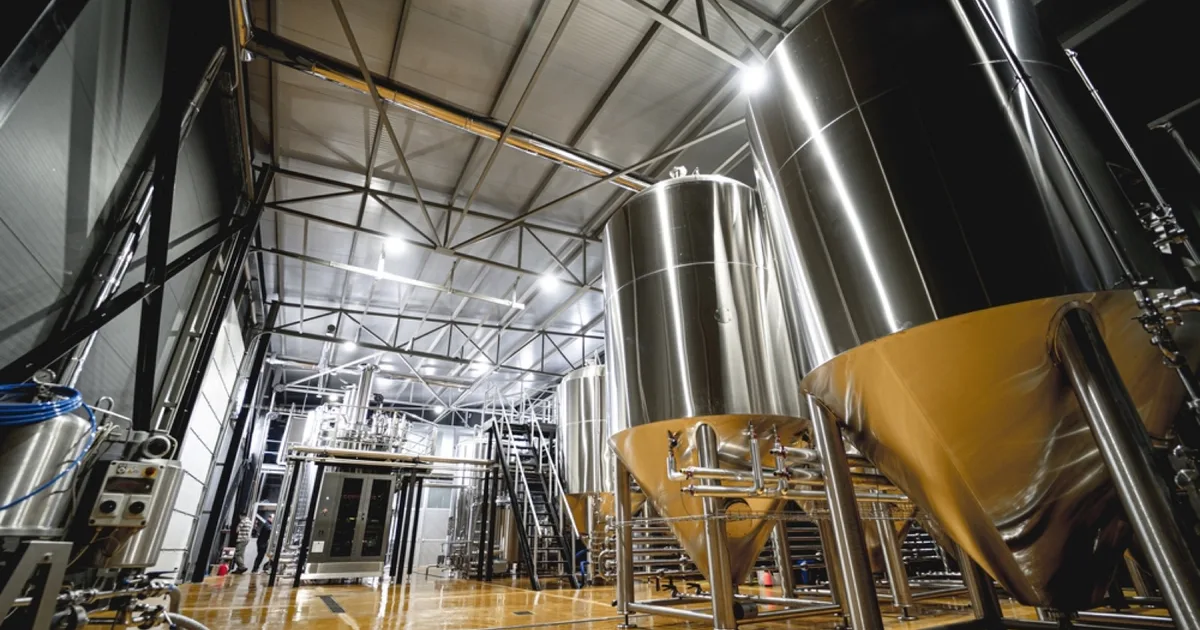
A craft brewery producing 2,000 hectolitres a year will consume somewhere between 16,000 and 30,000 kWh of electricity in the process — before you add refrigeration, packaging, taproom lighting, and the office. For a microbrewery running a 5-barrel kit, the electricity bill alone will typically sit between £800 and £1,500 a month. Gas, if the brewery uses it for liquor heating rather than electric elements, adds a further substantial cost that tracks closely with brew volume. Brewing is an energy-intensive process, and the energy cost per hectolitre is one of the most controllable inputs in a craft brewer’s margin.
Where the energy goes
The kWh-per-hectolitre benchmark for small craft breweries — typically in the range of 8 to 15 kWh/hl — disguises considerable variation between process stages. Wort production (mashing, lautering, boiling, and whirlpool) is the dominant thermal load for gas-heated systems, with the boil alone typically consuming 3 to 4 kWh/hl. The transition to fermentation involves wort chilling — bringing the boiled wort from near 100°C down to pitching temperature in 20 to 30 minutes — which is where a plate heat exchanger connected to a glycol chilling system carries most of the electrical load.
Refrigeration is the dominant continuous electrical cost in any brewery. Fermentation and conditioning require temperature control across multiple vessels simultaneously. A brewery with 20 fermenters and conditioning tanks running at any one time may have 15 to 20kW of refrigeration plant running more or less continuously. Compressed air — for transfer, packaging, and cleaning — is the third significant energy user. Compressors are often old, inefficient, and running more hours than necessary, particularly in breweries that have grown incrementally.
Clean-In-Place (CIP) systems, which sterilise vessels and pipework between brews, are energy-intensive precisely because sterilisation requires sustained high temperatures. Thermal insulation of CIP circuits is one of the most cost-effective brewery investments and one of the most commonly overlooked.
Heat recovery: the underused asset
Wort chilling generates substantial waste heat in the cooling water circuit. A heat exchanger used to chill 1,000 litres of wort from 95°C to 18°C will heat an equivalent volume of cold water to approximately 75 to 80°C. That hot liquor is directly usable for the next brew’s strike water, reducing the energy required to heat liquor from cold. Breweries that capture this heat consistently report electricity and gas savings of 10 to 20% on their per-brew energy cost.
The capital cost of a basic hot liquor recovery system is modest — a well-insulated hot liquor tank and appropriately sized pipework — and the payback period at current energy prices is typically under two years for a brewery producing more than one brew per week.
Gas and electricity: a coordinated procurement approach
Many breweries have their gas and electricity contracts with different suppliers, renewed at different times, managed by whoever is least busy when the renewal notice arrives. This means the two largest energy inputs are being procured independently, without strategic coordination. The case for aligning gas and electricity contract timings is straightforward: both prices are influenced by common market factors, so the optimal timing for procurement of both is similar. Going to market for both simultaneously also gives suppliers a larger commercial opportunity to price for.
For a brewery with predictable brew schedules, the gas consumption profile is unusually foreseeable — brew days create identifiable demand spikes that a supplier can model accurately. This predictability is an asset in procurement. Suppliers who can see a reliable, repeatable consumption pattern price it more tightly than they would an erratic profile.
The procurement angle: process loads are your advantage
Brewing’s combination of high consumption and highly predictable process loads makes it one of the more straightforward sectors to procure energy for — if the procurement is done by someone who understands the consumption profile. A brewery that can show a supplier 12 months of half-hourly data, with brew days clearly identifiable as demand peaks, is offering a pricing exercise that carries less uncertainty than most commercial tenders. We work with breweries of all sizes, from microbreweries with a single HH meter to regional producers with multiple site contracts.
📱 WhatsApp: 07360 272168 | 📧 hello@telnergy.com | 📞 01202 028888 Telnergy Limited · Independent commercial energy consultancy since 2002 · Ofgem-aligned consultancy · ADR Ref E3561 · CRN 04576876 · Christchurch, Dorset
FAQ
Should a craft brewery use gas or electric for liquor heating? At current energy prices, gas remains cheaper per kWh of heat delivered in most scenarios, even accounting for boiler efficiency losses — though the gap has narrowed since the 2021–22 gas price shock. Electric elements offer simpler installation and no combustion risk, and they become more competitive where you have access to off-peak or time-of-use electricity tariffs. The procurement decision should inform the capital decision, not the other way around.
We’re a small microbrewery producing fewer than 500hl per year. Is it worth getting an energy broker involved? Yes, for two reasons. First, even at small consumption volumes the savings from a well-negotiated contract can exceed £1,000 to £2,000 a year — which matters at microbrewery margins. Second, a broker can identify whether you’re on the right meter type and contract category for your consumption pattern, which is a surprisingly common issue for breweries that have grown from a homebrew origin.
Our brewery is planning to install solar PV. Does that change how we should procure grid electricity? Yes, significantly. If you’re installing generation that will offset grid import during daytime brew hours, your grid consumption profile changes materially. You’ll want to procure for your net import profile rather than your gross consumption. We’d recommend completing the procurement analysis before the PV installation goes live, since the optimal contract structure post-installation is different from the optimal pre-installation contract.
Telnergy Limited is an independent commercial energy consultancy established in 2002, based in Christchurch, Dorset. Ofgem-aligned consultancy · ADR Ref E3561 · CRN 04576876.