
Commercial Kitchen Energy Audit
A commercial kitchen uses 3\u20135 times more energy per square metre than the rest of a building. For a restaurant with a 200m\u00b2 kitchen, that translates to an annual energy bill of \u00a320,000\u2013\u00a340,000 before factoring in gas for cooking. Most of that is spent on equipment that is at least partially inefficient \u2014 not because it is broken, but because small operational habits, maintenance gaps, and configuration defaults accumulate into significant waste. A targeted energy audit typically identifies 15\u201325% reduction opportunity, with 60% of that achievable through operational changes that cost nothing to implement.
The equipment audit
Combi ovens are the highest energy-intensity item in most professional kitchens. Preheat habits account for a significant proportion of oven energy use \u2014 a 20-minute preheat instead of 10 adds several hundred pounds per year in unnecessary consumption on a busy operation. Door seal integrity deteriorates with use and often goes unchecked until the seal visibly fails; a degraded seal increases heat loss and extends cooking cycles. Auto-clean cycles set to run overnight when the oven is not in use waste water and energy. Each of these is a configuration or behavioural issue, not a capital investment problem.
Fryers combine high energy draw with operational variability. Thermostat calibration drift is common \u2014 a fryer maintaining 180\u00b0C when the set point is 160\u00b0C uses approximately 15% more energy per cycle, adds to oil degradation costs, and affects food quality. Idle temperature settings matter on a quiet service: maintaining full operating temperature during a slow period burns the same energy as a busy one. Training staff to drop to a standby temperature during defined lulls typically saves \u00a3300\u20131,000 per year per fryer.
Extraction systems are frequently oversized relative to actual cooking load, running at full capacity regardless of what is on the range. Demand-controlled kitchen ventilation \u2014 systems that modulate fan speed based on thermal and pollution sensors above the cooking equipment \u2014 can reduce extraction energy by 30\u201350% without affecting air quality. For a system costing \u00a31,000\u20133,000 per year to run, this is a material saving with a straightforward payback.
Hidden loads
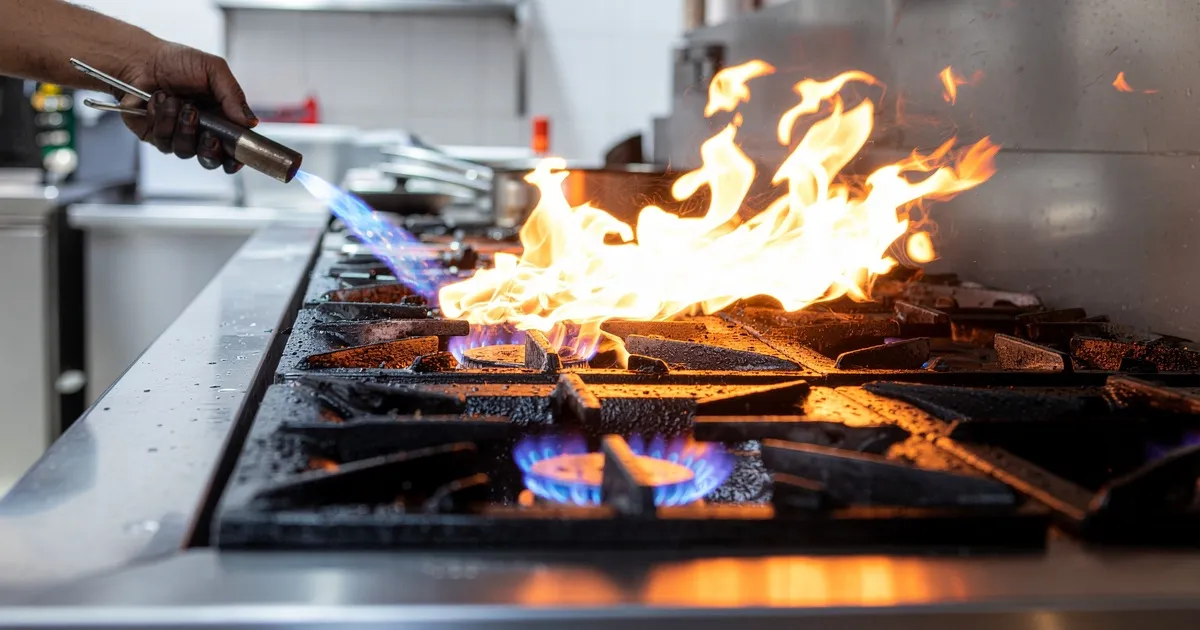
Pilot lights on gas equipment left running outside service hours are one of the most consistent findings in commercial kitchen audits. A gas pilot flame consuming 0.1\u20130.3 kW continuously adds \u00a3150\u2013450 per appliance per year \u2014 significant for a kitchen with multiple pieces of gas-fired equipment. Systematic shutdown of gas ignition systems at close of service addresses this at zero cost.
Hot water systems are often misconfigured. Calorifier temperatures set higher than necessary for hot water safety \u2014 the minimum is 60\u00b0C at the calorifier, not 80\u00b0C \u2014 waste energy in standing losses. Time-clock settings are frequently not adjusted for actual service patterns, with systems maintaining temperature overnight when there is no draw. Legionella compliance is a genuine constraint on temperature management, but it does not require the maximum possible operating temperature at all times.
The procurement connection
A kitchen that has reduced its consumption profile through an audit is a different supply proposition from one that hasn\u2019t. Suppliers price contracts based on usage patterns. A site with a lower overnight baseload, controlled peak demand, and a documented reduced consumption profile following the audit will attract more competitive quotes \u2014 particularly for flexible or pass-through contracts where the reduced profile directly improves the supplier\u2019s hedging economics. Audit before renewal, not after. The consumption profile you present to suppliers at tender should reflect the improved position, not the pre-audit waste.
📱 WhatsApp: 07360 272168 | 📧 hello@telnergy.com | 📞 01202 028888 Telnergy Limited · Independent commercial energy consultancy since 2002 · Ofgem-aligned consultancy · ADR Ref E3561 · CRN 04576876 · Christchurch, Dorset
FAQ
How much can a commercial kitchen energy audit realistically save?
Most commercial kitchens waste 15\u201325% of energy through operational inefficiency, equipment misconfiguration, and hidden loads. The majority of this is recoverable through zero or low-cost changes \u2014 behaviour, scheduling, and configuration adjustments \u2014 with capital investments in equipment and controls adding further savings. For a kitchen with a \u00a330,000 annual energy bill, a well-implemented audit programme typically delivers \u00a34,000\u20137,500 per year in savings.
What are the biggest energy hogs in a typical commercial kitchen?
Extraction systems and combi ovens account for the largest proportion of electricity use. Gas fryers and ovens dominate gas consumption. But the highest-return audit findings are often the hidden loads \u2014 pilot lights, misconfigured water heaters, and refrigeration running with degraded door seals \u2014 because these are pure waste that can be eliminated immediately at no cost.
How does a kitchen energy audit improve my energy contract?
A post-audit consumption profile with lower overnight baseload and reduced peak demand is cheaper for suppliers to serve and hedge. Presenting this improved profile at tender \u2014 rather than the pre-audit one \u2014 produces more accurate and more competitive quotes. The procurement saving compounds the efficiency saving: lower consumption volume at a better unit rate.
Telnergy Limited is an independent commercial energy consultancy established in 2002, based in Christchurch, Dorset. Ofgem-aligned consultancy · ADR Ref E3561 · CRN 04576876.