
Energy Management Software for UK Businesses: A Practical Guide
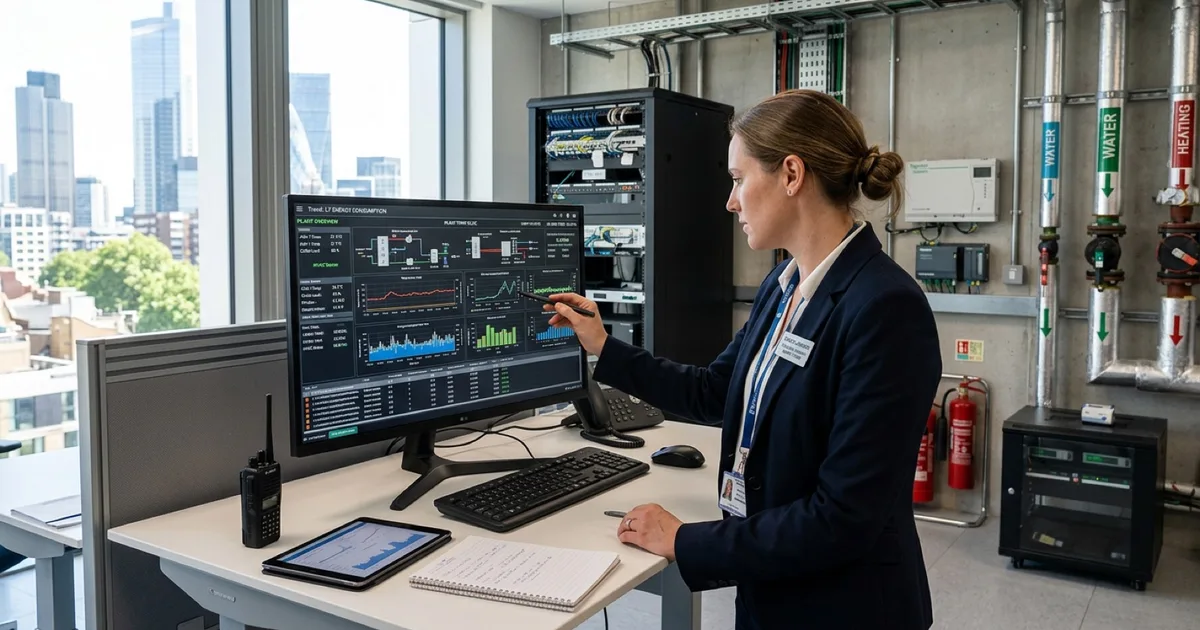
Energy management software has moved from a niche tool used by large corporates into something that genuinely makes financial sense for mid-sized UK businesses. But the market is fragmented, the terminology is inconsistent, and a lot of providers make claims that don’t survive contact with reality. This guide cuts through that and gives you a clear picture of what these systems actually do, what they cost, and when they’re worth buying.
What Energy Management Software Actually Does
At its core, an energy management system (EMS) software does three things: it collects your meter data, it makes sense of it, and it tells you when something is wrong.
The data collection side draws from several sources depending on your setup. Automated Meter Reading (AMR) meters send consumption data remotely, typically in half-hourly intervals. Half-hourly (HH) metered sites — any electricity meter with a maximum demand above 100kW, and increasingly smaller sites — feed data directly to data collectors and data aggregators under the BSC (Balancing and Settlement Code) framework. Smart meters connected to the DCC (Data Communications Company) network can be accessed via API. For gas, pulse data loggers and AMR gas meters send interval reads. Where none of these are available, data arrives by manual CSV upload or manual entry — which is exactly the kind of human error these platforms are designed to reduce.
Once collected, good software normalises the data. Degree-day normalisation is particularly important: it adjusts consumption figures to account for weather, so you’re comparing like with like when you look at heating-season versus summer energy use. Without that normalisation, a spike in January gas consumption looks alarming when it may simply reflect a cold month.
The reporting layer surfaces exceptions — consumption outside expected ranges, periods of unexplained overnight load, sites with higher-than-benchmark intensity — and generates reports for internal management and external compliance requirements.
EMS Software, Sub-Metering Platforms, and ISO 50001 Systems: What’s the Difference?
These three categories overlap but aren’t interchangeable, and buying the wrong one wastes money.
Utility management platforms focus on invoice and meter data management at a portfolio level. They’re built for organisations managing multiple meters across multiple sites — think retail chains or hospitality groups. The primary value is bill validation (catching billing errors, which are surprisingly common), portfolio reporting, and feeding data into SECR and ESOS submissions. Utiligroup, Trax, and Stark are the established names in UK utility management. These platforms don’t typically connect to on-site sub-meters; they work with supplier data feeds and meter reads.
Sub-metering and building monitoring platforms go deeper into the building itself. They connect to BMS (Building Management Systems), sub-meters on individual circuits or equipment, and IoT sensors. Siemens and Schneider Electric offer integrated BMS solutions with energy analytics built in, which suits larger commercial or industrial sites where the granularity of data justifies the cost and complexity. Cloud SaaS platforms like Carbon Desktop and Meazon sit in a middle ground — they aggregate data from multiple sources including smart meters and sub-meters, present it in accessible dashboards, and increasingly incorporate carbon reporting. These are well-suited to SMEs and regional multi-site operators.
ISO 50001-compliant systems add a procedural and evidential layer on top of the data. ISO 50001 is the international standard for energy management systems — it requires documented energy review processes, performance indicators, targets, and management review. Software that supports ISO 50001 implementation needs audit trail functionality, formal action tracking, and structured reporting that demonstrates continual improvement. Not every business needs this: it’s most relevant for manufacturers, large distributors, and businesses facing supply chain pressure to demonstrate energy governance.
Key Features to Look For
When evaluating any platform, the following capabilities separate genuinely useful tools from expensive dashboards that collect data and do little else.
Automated data collection should cover AMR, HH data feeds, and smart meter API connections without requiring manual intervention. The moment you rely on someone uploading a spreadsheet monthly, you introduce delays and errors. The best platforms have direct connections to data collectors and data aggregators, so your portfolio is always current.
Degree-day normalisation is non-negotiable if you have any heating or cooling load. Without it, your year-on-year comparisons are distorted by weather variation and you can’t reliably identify underlying efficiency trends.
Alerting and bill validation is where many businesses see the fastest return. Billing errors — estimated reads left in place, wrong tariff applied, meter data attributed to the wrong MPAN — are common enough that a good platform can pay for itself on bill savings alone. Alerts can also flag unusual consumption patterns in near real-time: a water leak on a Saturday night, an HVAC unit left running in an unoccupied building, a compressed air system with a significant overnight load.
Supplier API integration enables direct data exchange with your energy suppliers, reducing reliance on manual meter reads and enabling faster data reconciliation.
SECR and ESOS reporting — if you’re a large company under Streamlined Energy and Carbon Reporting (SECR) obligations, or subject to the Energy Savings Opportunity Scheme (ESOS), your software needs to produce the required outputs without significant manual data processing. Check whether the platform can generate the specific metrics the regulations require, not just a general carbon report.
Carbon reporting that goes beyond kWh totals to calculate Scope 1 and Scope 2 emissions using current DEFRA conversion factors is increasingly expected by investors, supply chains, and public sector procurement bodies.
Main Categories in the UK Market
The UK energy software market broadly divides into three tiers.
At the enterprise end, utility management platforms from Utiligroup, Trax (now part of a larger group), and Stark handle large portfolios — typically 50+ meters — for retailers, pub chains, housing associations, and local authorities. These platforms have sophisticated bill validation engines, EDI data feeds from suppliers, and compliance reporting baked in. They’re priced accordingly.
In the mid-market, cloud SaaS platforms like Carbon Desktop and Meazon offer accessible interfaces, faster implementation, and pricing that works for SMEs with 5–50 meters. Carbon Desktop has a strong following among UK businesses wanting to combine energy monitoring with carbon reporting. Meazon brings IoT connectivity and sub-meter integration at a more accessible price point than traditional BMS integrations.
At the building systems level, Siemens and Schneider Electric provide BMS-integrated energy analytics as part of broader building automation projects. These make sense when you’re already investing in building controls infrastructure — the energy analytics come as part of the platform rather than as a standalone purchase.
How Much Does Energy Management Software Cost?
Pricing varies enormously and depends on the number of meters, the level of data integration, and the sophistication of reporting you need.
Basic cloud monitoring for a small number of meters — half-hourly data pulled from smart meters, simple dashboards, basic alerting — starts at roughly £200 per site per year. At this price point you’re getting data visibility, not a full management system.
Mid-range platforms covering automated data collection, bill validation, degree-day normalisation, and SECR reporting typically cost £500–£2,000 per site per year, with discounts for larger portfolios. A ten-site business might expect to pay £5,000–£12,000 annually for a platform that genuinely handles the full data management workflow.
Enterprise utility management platforms and ISO 50001-supporting systems start at £10,000 per year and can reach £50,000+ for large, complex portfolios. Implementation costs — data migration, training, integration with existing systems — are additional and can match or exceed the first year’s licence fee.
It’s worth noting that many platforms charge per meter rather than per site, which matters if you have multiple meters at a single location (common in manufacturing or large retail).
When Do You Actually Need Software?
The honest answer is that a spreadsheet is fine for a business with two or three meters and a combined energy spend under £50,000 per year. If someone is reviewing your invoices monthly and knows what consumption should look like, the marginal benefit of a software platform is limited.
The rough rule of thumb we use: if you have five or more meters, or your total energy spend exceeds £50,000 per year, energy management software is likely to pay for itself — through bill validation savings, efficiency improvements identified by better data, and time saved on compliance reporting. At ten or more meters, the case becomes compelling. At 20+ meters, the cost of not having proper data management tends to show up in billing errors, missed contract renewal windows, and compliance exposure.
The other trigger is regulatory. If you’re subject to ESOS (obligatory for businesses with 250+ employees or £44m+ turnover), you need structured energy data and audit evidence regardless of how many meters you have. A software platform makes ESOS compliance significantly less painful.
The Data Input Question
This is where many implementations fall down. A platform is only as useful as the data feeding into it, and data quality issues are endemic across the UK energy sector.
Half-hourly metered sites have the cleanest data flow: HH data flows automatically from your data collector, and most platforms can ingest this directly. Non-half-hourly meters (the majority of smaller sites) historically required manual reads or estimated consumption, though the smart meter rollout is improving this. Where smart meters are installed, the DCC API allows platforms to pull actual reads without supplier intermediaries.
For gas, the picture is more fragmented. Smart gas meters don’t communicate to the DCC network in the same way as electricity meters, so gas data often relies on AMR pulse logging or monthly supplier reads. This is improving but remains a weak point for businesses with significant gas consumption.
Manual CSV upload remains necessary for some meters, legacy systems, and international sites. The key is ensuring your platform has good data quality flagging so you know when you’re working with estimated rather than actual data.
Integration with Procurement
A point that often gets missed: your energy management software and your procurement strategy should talk to each other.
If you’re on a fixed-price contract, your EMS data tells you whether your consumption profile matches what you contracted for — and if not, where the variance is coming from. This matters at renewal: a supplier that can see your actual half-hourly load profile, rather than just an estimated annual volume, will price your contract more accurately (which should mean more competitively).
For businesses on flexible or structured purchasing arrangements — buying wholesale power in tranches rather than fixing a single contract price — real-time consumption data is essential. Your TPI or energy manager uses your actual load data to time purchases and assess tranche sizing.
At Telnergy, we work with clients’ EMS data as part of contract reviews. Seeing actual HH consumption patterns often changes the procurement recommendation: a business that assumed it was base-load turns out to have significant peak demand, or a site thought to be low-consumption is running large overnight loads. That data shapes which contract structure and which suppliers are likely to offer the best value.
Telnergy’s Approach to Software Selection
We’re deliberately tool-agnostic. We don’t have a commercial relationship with any software provider, and we don’t receive referral fees for recommending particular platforms. Our view is that the right tool depends on your business — and that buying an enterprise platform when a mid-range SaaS tool will do is a waste of money, just as using a spreadsheet when you have 20 meters and £500,000 in annual energy spend leaves savings on the table.
For clients with fewer than ten meters and a combined spend below £100,000, we typically recommend starting with a mid-market cloud platform — Carbon Desktop or similar — and building from there as the business grows or as data needs become more complex.
For larger multi-site operators, particularly in hospitality, retail, or healthcare where you have distinct site types and significant variation in consumption patterns, a utility management platform with proper bill validation and SECR reporting capability is usually the right investment.
For manufacturing or industrial clients, BMS integration and sub-meter data are often more valuable than utility-level reporting, and we’d look at solutions that bridge both.
We help clients shortlist platforms, evaluate data integration requirements, and in some cases project-manage implementation — not because we sell software, but because poor data is the single biggest barrier to effective energy management.
Frequently Asked Questions
Do I need energy management software if I’m already using a broker?
A broker manages your procurement — finding and fixing contracts with suppliers. Software manages your data — collecting, validating, and reporting on actual consumption. Most businesses need both, and they serve different functions. A broker without consumption data is working from estimated figures; software without procurement expertise leaves contract risk unmanaged.
Can I use my smart meter data without a third-party platform?
Your supplier can give you access to your smart meter data, usually through their online portal or a CSV download. This is sufficient for one or two meters if someone is actively reviewing it. Once you have multiple sites or need automated alerting, bill validation, or compliance reporting, you need a dedicated platform.
What’s the difference between SECR and ESOS, and do I need software for both?
SECR (Streamlined Energy and Carbon Reporting) applies to large UK companies (250+ employees, or £36m+ turnover and £18m+ assets) and requires energy and carbon data in the annual report. ESOS (Energy Savings Opportunity Scheme) applies to businesses with 250+ employees or £44m+ turnover and requires structured energy audits every four years. Software helps with both but is more critical for SECR, which is an annual regulatory requirement.
How long does it take to implement an energy management platform?
For a cloud SaaS platform with smart meter data, a basic implementation can be live within a few weeks. For enterprise platforms requiring data feeds from data collectors, historical data migration, and integration with procurement systems, three to six months is realistic. Larger implementations with BMS integration can take longer.
What if my data is a mess — estimated reads, missing meters, incomplete history?
This is more common than you’d think. Most platforms have data quality tools that flag estimated reads and gaps, and a good implementation will include a data cleanse exercise before going live. Don’t let imperfect historical data stop you from starting — it’s better to have clean data from a known date than to wait for perfection.
Can energy management software reduce my bills directly?
Software surfaces opportunities; it doesn’t reduce bills on its own. The reductions come from acting on what the data shows — fixing billing errors, addressing inefficiencies, adjusting contract structures, or changing operational behaviour. Businesses that use their monitoring data actively typically see 10–20% reductions in consumption over the first 18 months. Those that buy software and don’t act on the alerts see much less.
Telnergy is an independent commercial energy consultancy (Ofgem-aligned, ADR Ref E3561). We’ve helped UK businesses reduce energy costs since 2002. Get in touch to discuss your energy strategy.
Telnergy Limited is an independent commercial energy consultancy established in 2002, based in Christchurch, Dorset. Ofgem-aligned consultancy · ADR Ref E3561 · CRN 04576876.