
Green Energy Options for UK Businesses: What’s Worth It in 2026
Green energy for business is simultaneously more accessible and more confusing than it has ever been. The options are wider. The claims are noisier. And the gap between genuinely green supply and what gets marketed as green is wider than most business owners realise.
This isn’t an argument against going green — it’s a guide to navigating what actually exists in the UK market in 2026, what it costs, and what delivers real environmental value versus what delivers a green badge at inflated cost.
What Are the Main Green Energy Options for UK Businesses in 2026?
REGO-Backed Green Tariffs
The most common form of green business energy in the UK. REGO stands for Renewable Energy Guarantees of Origin — certificates that confirm a unit of electricity was generated from renewable sources. Suppliers purchase REGOs and use them to offer “green” tariffs to business customers.
The environmental integrity of REGO-backed tariffs is a genuine debate in the sector. Because REGOs can be purchased and matched to supply independently of when and where the renewable electricity was actually generated, a supplier can sell you green energy while your meter draws power from gas or coal generation. The certificate exists; the additionality — new green capacity being built because you chose a green tariff — frequently doesn’t.
That said, REGO tariffs are typically priced at a minimal or zero premium above standard rates. If your green energy commitment is primarily for ESG reporting or supply chain compliance purposes, they remain a cost-effective and administratively simple approach.
Power Purchase Agreements (PPAs)
A PPA is a direct supply agreement between your business and a renewable energy generator — a wind farm, solar park, or hydro project. You agree to purchase a set volume of electricity at a fixed price for a defined term, typically 5–15 years.
PPAs represent genuine additionality in most cases — particularly for newer projects where your commitment contributes to project financing. They also deliver price certainty over the contract term, which is a significant financial benefit given the volatility in UK wholesale gas markets over recent years.
The constraint: meaningful PPAs typically require consumption of 5–10 GWh per year or more, placing them out of reach for most SMEs without an aggregation arrangement. Aggregated PPAs — where multiple businesses pool consumption — are emerging but the market remains complex for smaller buyers.
On-Site Solar Generation
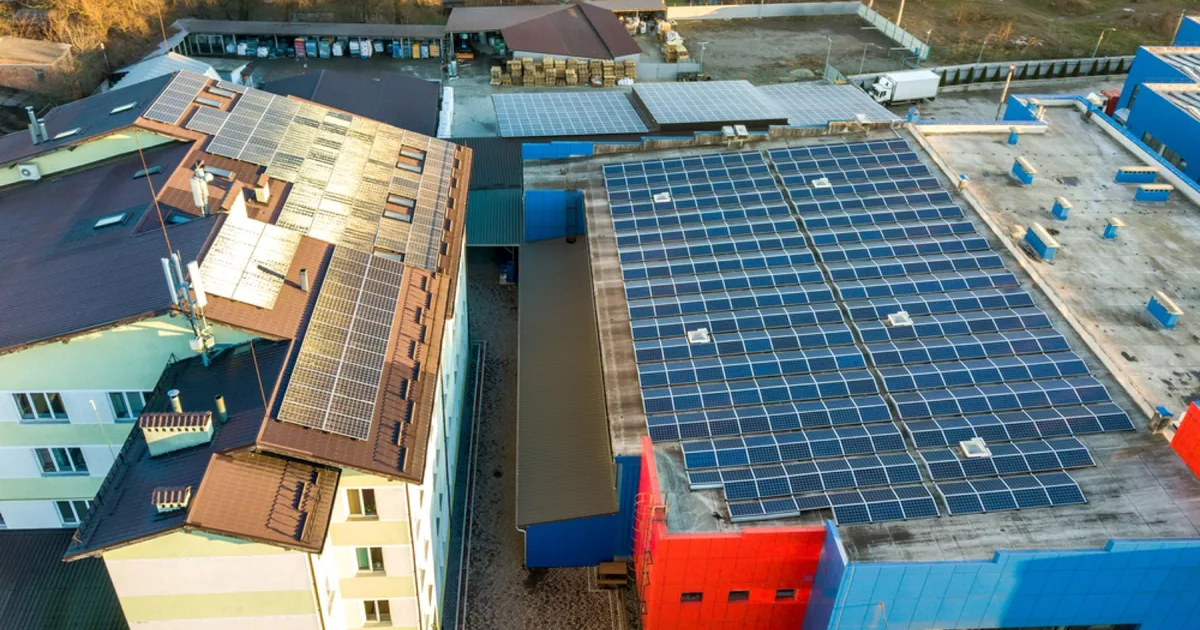
Solar PV is the primary on-site renewable option for most UK businesses with appropriate roof space or land. Capital costs have fallen substantially over the past decade — a 50kW rooftop system can now be installed for £35,000–£50,000 depending on specification, and typically delivers a payback period of 7–12 years based on self-consumption rates and current electricity prices.
Battery storage is increasingly paired with solar to improve self-consumption and reduce peak demand charges. The combination can reduce grid electricity consumption by 20–40% for well-matched operational profiles — highest for businesses with significant daytime energy loads such as manufacturing, food processing, and logistics.
Green Gas Tariffs
Biomethane — produced from organic waste and injected into the national grid — is the primary source of green gas available to UK businesses. Green gas tariffs work similarly to REGO electricity: suppliers purchase Guarantees of Origin certificates and use them to offset the gas they deliver to your meter.
Green gas tariffs typically carry a premium of 5–15% over standard gas rates. Supply of genuinely verified green gas remains constrained relative to demand, and the same additionality questions apply as with REGOs.
What’s Actually Worth It for Most UK SMEs?
The honest answer depends on your motivation:
- ESG reporting and supply chain compliance: A REGO-backed green electricity tariff at minimal cost premium covers most reporting requirements. Check what your customers or investors specifically require before paying more.
- Genuine carbon reduction: On-site solar combined with a demand reduction programme delivers measurable Scope 2 emission reductions. PPAs are the next step if your consumption scale supports them.
- Cost management plus green credentials: Solar PV with battery storage offers the most credible combination of genuine renewable generation and commercial payback — particularly with current electricity prices in the 22–28p/kWh range.
- Net Zero pathway compliance: If you have formal Net Zero commitments, a REGO tariff alone is increasingly insufficient for credible reporting. Science-based target frameworks typically require genuine additionality and consumption matching.
What to Watch Out For
Green energy marketing in the business sector is not consistently regulated for environmental claims. Specific things worth scrutinising:
- “100% renewable” on a standard tariff — often means REGO-matched, not physically renewable. Legitimate, but understand what you’re getting.
- Green premium without additionality explanation — if a supplier charges a significant premium for a green tariff but can’t explain how your purchase supports new renewable capacity, the premium is hard to justify.
- On-site solar proposals with unrealistic generation estimates — UK solar yields are well-documented. Be sceptical of proposals projecting over 1,100 kWh/kWp annually in most UK locations.
The Telnergy View
We are independent energy consultants, not renewable energy developers. Our role is to give UK businesses a clear commercial picture of what each green option actually delivers, what it costs, and whether the claims being made on its behalf stand up.
In our experience, most SMEs are best served by securing a competitively priced fixed-term contract first — green or standard — and evaluating on-site generation separately as a capital investment decision with its own payback analysis. Paying a significant green premium on a poorly negotiated base contract is rarely the right order of operations.
If you want an honest assessment of which green energy options make sense for your specific business, the conversation starts here.
📱 WhatsApp: 07360 272168 | 📧 Email: hello@telnergy.com | 📞 Phone: 01202 028888
Telnergy Limited · Independent commercial energy consultancy since 2002 · Ofgem-aligned consultancy · ADR Ref E3561 · CRN 04576876 · Christchurch, Dorset
Telnergy Limited is an independent commercial energy consultancy established in 2002, based in Christchurch, Dorset. Ofgem-aligned consultancy · ADR Ref E3561 · CRN 04576876.