
How to Build an Energy Reduction Plan
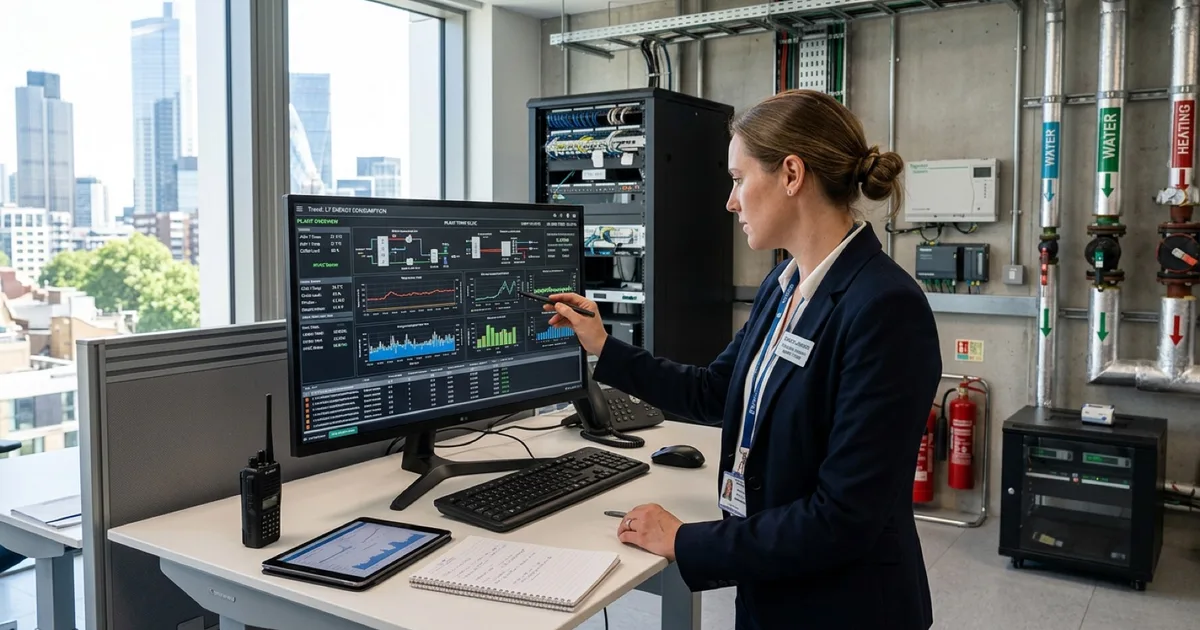
UK SMEs that have never systematically focused on energy management can typically achieve 10\u201320% reduction in total energy costs in the first year through a structured approach applied for the first time. That is a pattern observed consistently across sectors \u2014 hospitality, manufacturing, retail, professional services \u2014 not a government target figure. The question is not whether the savings exist. It is whether the plan to capture them is specific enough to survive contact with the operational day-to-day, or whether it dissolves into good intentions by February.
The difference between a plan and a wishlist
An energy reduction plan has four characteristics a wishlist lacks: specific, measurable targets (not \u201creduce energy use\u201d but \u201creduce electricity consumption by 12% against the 2024 calendar year baseline by December 2026\u201d); named ownership (a specific person accountable for each action, not \u201cthe team\u201d); a timeline (actions are scheduled, not aspirational); and a measurement method (the mechanism by which you will know whether each action delivered what it was supposed to). Without these four elements, the document gets drafted, presented at a management meeting, and filed. With them, it becomes the basis for a quarterly review conversation that has a specific number to explain or defend.
Building the baseline
You cannot plan a reduction without a baseline to reduce from. The baseline requires a minimum of 12 months of actual consumption data \u2014 not estimated billing, which smooths out the patterns that drive the plan. Ideally 24 months, which allows seasonal patterns to be clearly established and anomalies distinguished from trends. For businesses with multiple energy uses, the baseline should be fuel-specific. Electricity and gas have different efficiency levers, different contract dynamics, and different capital investment profiles. Conflating them into a single \u201cenergy\u201d figure obscures what is driving costs and what the priority actions are.
Where possible, normalise the baseline for output (a manufacturer normalises by production volume; a hotel by occupied room nights) and for weather (heating-intensive businesses adjust gas consumption for heating degree days). Normalised baselines allow genuine year-on-year performance comparisons that are not distorted by a cold winter or an unusually strong trading period.
Prioritising by return on investment
Not all efficiency opportunities are equal, and the sequence of implementation matters. The correct order is operational and behavioural changes first \u2014 heating setpoint adjustments, scheduling improvements, out-of-hours shutdown disciplines \u2014 then controls and maintenance investments, then capital projects such as LED conversion, HVAC replacement, or on-site generation. This sequence is correct not because operational changes are always the biggest opportunity \u2014 they often are not \u2014 but because they cost least to implement, they reveal the true baseline, and they ensure capital investments are sized correctly. An LED retrofit specified against a lighting baseline that still includes unnecessary out-of-hours operation will overstate the saving. Fix the behaviour first, invest capital against the residual.
The procurement connection
An energy reduction plan that delivers a 15% reduction in annual consumption changes the contract volume you need to tender at the next renewal. If the plan is credible \u2014 supported by a documented baseline, with specific actions and timelines \u2014 it is worth tendering the next contract against the projected reduced volume rather than the historical volume. Suppliers will price the new profile, and you will not be locked into paying for capacity you are systematically eliminating. Telnergy aligns reduction plans with contract timing for this reason. A business implementing LED across its estate in Q1 2026 and going to market for a new electricity contract in Q2 should present suppliers with the post-LED consumption profile, not the pre-LED one. The procurement saving on the right volume compounds the efficiency saving.
📱 WhatsApp: 07360 272168 | 📧 hello@telnergy.com | 📞 01202 028888 Telnergy Limited · Independent commercial energy consultancy since 2002 · Ofgem-aligned consultancy · ADR Ref E3561 · CRN 04576876 · Christchurch, Dorset
FAQ
How much energy reduction can a typical SME achieve in year one?
For a business with no prior systematic energy management, 10\u201320% in year one is achievable through a combination of operational improvements and targeted low-cost interventions. The upper end requires active management \u2014 regular consumption monitoring, rapid response to anomalies, and disciplined implementation. The lower end is achievable through basic controls optimisation and out-of-hours shutdown improvements alone.
What is the right interval for reviewing progress?
Quarterly as a minimum, monthly for businesses with significant energy spend or complex consumption profiles. The review compares actual consumption \u2014 normalised where appropriate \u2014 against the plan baseline and identifies variance. Positive variance triggers investigation. Negative variance is worth understanding too, to confirm that genuine efficiency improvements are driving it rather than lower production activity.
Should I implement the reduction plan before or after renewing my contract?
Implement first where the timeline allows. A contract tendered against a reduced consumption baseline will attract better pricing than one tendered against the pre-reduction profile. The exception is where your contract is expiring imminently and waiting would mean going out of contract on expensive deemed rates. In that case, renew on a shorter term at the best available rate, implement the reduction plan during the contract, and tender again at renewal against the improved profile.
Telnergy Limited is an independent commercial energy consultancy established in 2002, based in Christchurch, Dorset. Ofgem-aligned consultancy · ADR Ref E3561 · CRN 04576876.