
Leisure Centre Energy Costs: Managing the Bill Behind the Pool and the Gym Floor
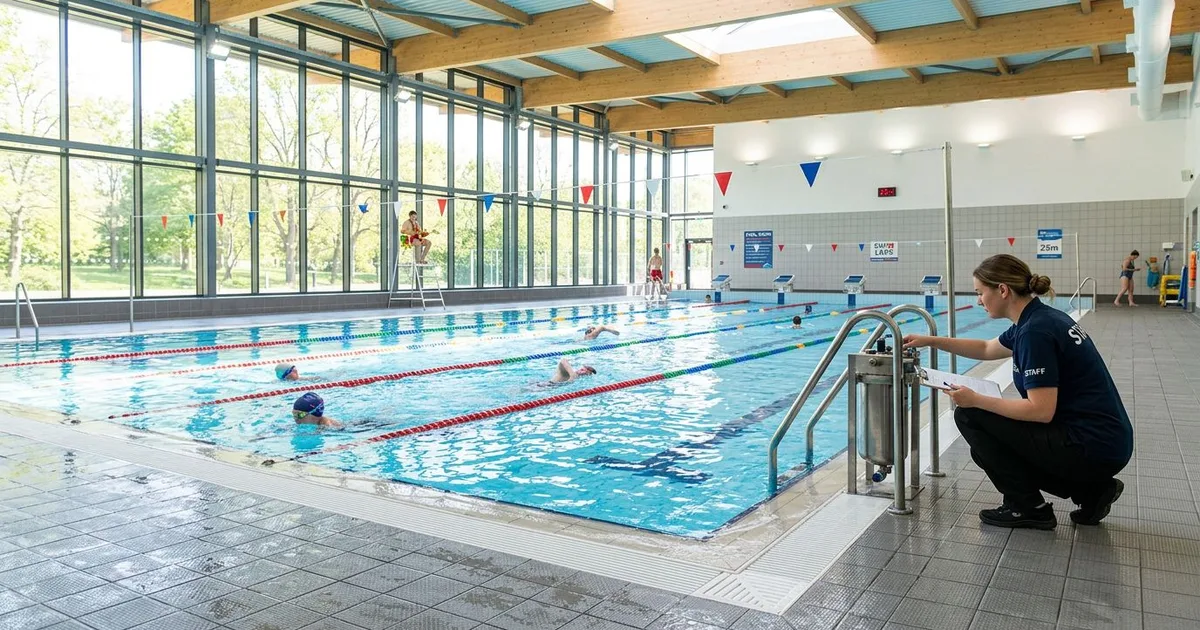
A community leisure centre with a 25-metre swimming pool can spend £150,000 or more on energy every year. For privately operated gyms and fitness centres without a pool, the figure is lower but still material — typically £15,000–60,000 depending on size and equipment. In both cases, energy is usually the second or third largest operating cost, and in most facilities it’s being managed far less systematically than it could be.
Figures are Telnergy estimates based on typical consumption profiles: a 25m × 12.5m pool held at 28–30°C with 14–16 hour operating days, and pool-free gyms of 500–2,000 m². Your actual spend depends on plant age, occupancy and contract structure — book a free half-hourly data review for a site-specific number.
Pool facilities: where the cost sits
For leisure centres with pools, water heating is the dominant cost — typically 60–70% of total energy consumption. Heating pool water requires approximately 8–15 kWh per cubic metre, and maintaining a standard 25m x 12.5m pool at 28–30°C against continuous heat loss from evaporation, ventilation, and the pool shell represents a substantial ongoing thermal load.
Pool hall HVAC adds a further significant cost. Natatorium dehumidification — controlling the humid air environment to prevent condensation damage to the building fabric — requires sustained mechanical ventilation. Heat recovery from the dehumidification process, where installed, can recover 50–70% of the energy that would otherwise be exhausted, but many older facilities still operate without it.
Filtration pumps run 24 hours a day for water quality compliance. Retrofitting variable speed drives to pool filtration pumps — running at reduced speed during low-bather periods overnight — is one of the most consistent ROI improvements available to pool operators. The cubic law applies here as it does to any centrifugal pump.
For a fuller operational sweep, use our practical leisure centre energy efficiency checklist alongside your half-hourly data.
Gym and fitness facilities
In facilities without pools, HVAC is the largest cost driver. Gym environments require high fresh air ventilation rates — typically 8–15 litres per second per person — to maintain air quality under heavy occupancy. The energy cost of ventilating a busy gym floor is significant, and many facilities run ventilation at design maximum regardless of actual occupancy.
Occupancy-responsive ventilation — CO₂ sensors modulating fresh air supply to match actual demand — can reduce HVAC energy by 20–30% in a typical fitness facility without any impact on air quality. The capital cost is relatively low compared with the annual saving at current electricity prices.
Lighting in sports halls, studios, and reception areas is well-suited to LED conversion with occupancy sensing. Studios between classes, changing rooms at off-peak times, and car parks overnight are all candidates for significant reduction with minimal investment.
Where does your centre’s spend actually sit?
Most operators are managing energy far less systematically than they could be. We’ll review 12 months of your half-hourly data and show you exactly where the money goes — and what’s recoverable — at no cost.
Book a free half-hourly data review → · 01202 028888 · hello@telnergy.com
CHP for pool facilities
Combined heat and power (CHP) is particularly well-suited to leisure facilities with pools because it requires a sustained, high base heat load to make economic sense. A pool facility consuming £80,000+ in energy per year, with a significant heating demand running year-round, often has the consumption profile to justify a CHP assessment. The economics have tightened with the rise in gas prices since 2021, but for larger facilities with on-site power purchase agreements or export capability, CHP remains worth evaluating.
The important question is not just whether CHP can save money today, but whether it remains the right long-term decision once grant eligibility, gas offtake terms and future heat decarbonisation are considered. We cover that decision in more detail here: whether CHP still stacks up for your pool.
VAT and CCL treatment
Leisure facilities operated by local authorities or registered charities may qualify for the 5% reduced rate of VAT on energy rather than the standard 20%. The eligibility criteria relate to the proportion of use that qualifies as non-business activity — charitable leisure provision rather than commercial gym operation. If your facility has mixed commercial and charitable use, the VAT position warrants review; many organisations are paying the wrong rate.
Climate Change Levy exemption may also apply where facilities have an appropriate Climate Change Agreement in place. The leisure sector has sector-specific CCAs that can significantly reduce the CCL element of electricity and gas bills for compliant operators.
Procurement for leisure
Leisure facilities have a demand profile that favours careful contract selection. Peak consumption occurs during evening and weekend sessions; overnight baseload from filtration, heating maintenance, and security is significant but lower than trading hours. For larger sites on half-hourly metering, a pass-through contract with time-differentiated network charges can deliver better value than an all-inclusive blended rate — particularly if overnight filtration and HVAC setbacks reduce consumption during the most expensive network charge periods.
Telnergy has experience across both public sector leisure trusts and privately operated fitness operators. If you want to assess whether your current contract structure is appropriate for your consumption profile, we’re happy to review your data.
Where does your centre’s spend actually sit?
Most operators are managing energy far less systematically than they could be. We’ll review 12 months of your half-hourly data and show you exactly where the money goes — and what’s recoverable — at no cost.
Book a procurement review → · 01202 028888 · hello@telnergy.com
📱 WhatsApp: 07360 272168 | 📧 hello@telnergy.com | 📞 01202 028888
Telnergy Limited · Independent commercial energy consultancy since 2002 · Ofgem-aligned consultancy · ADR Ref E3561 · CRN 04576876 · Christchurch, Dorset
FAQ
What temperature should a pool be maintained at to balance cost and compliance?
PWTAG (Pool Water Treatment Advisory Group) guidance recommends 28–30°C for general swimming pools. Each degree of pool temperature reduction saves approximately 10% of pool heating energy — so operating at 28°C rather than 30°C can save 20% of the pool’s thermal load. Lane swimming and fitness pools can often operate at the lower end; learner and leisure pools typically require the higher end for comfort.
Is solar thermal worth considering for pool heating?
Solar thermal can contribute meaningfully to pool heating from April through September in the UK, when solar gain is highest and the supplementary heating load is lowest. For outdoor pools, it’s often the primary consideration. For indoor pools, solar thermal covers a portion of the annual heating load — typically 20–40% depending on the system size and roof orientation — and the payback period is usually 5–10 years. It works best combined with pool covers to retain the heat generated overnight.
Our leisure centre is local authority operated — how does procurement work?
Local authority leisure facilities can procure energy via the council’s existing framework agreements, or independently if the facility operates as a trust or arm’s-length entity. Framework pricing is not always the most competitive — direct tender to the open market through an independent broker often delivers better rates, particularly for larger sites where volume creates genuine negotiating leverage.
Telnergy Limited is an independent commercial energy consultancy established in 2002, based in Christchurch, Dorset. Ofgem-aligned consultancy · ADR Ref E3561 · CRN 04576876.
Telnergy Limited is an independent commercial energy consultancy established in 2002, based in Christchurch, Dorset. Ofgem-aligned consultancy · ADR Ref E3561 · CRN 04576876.