
What Is an Energy Management System (EMS)?
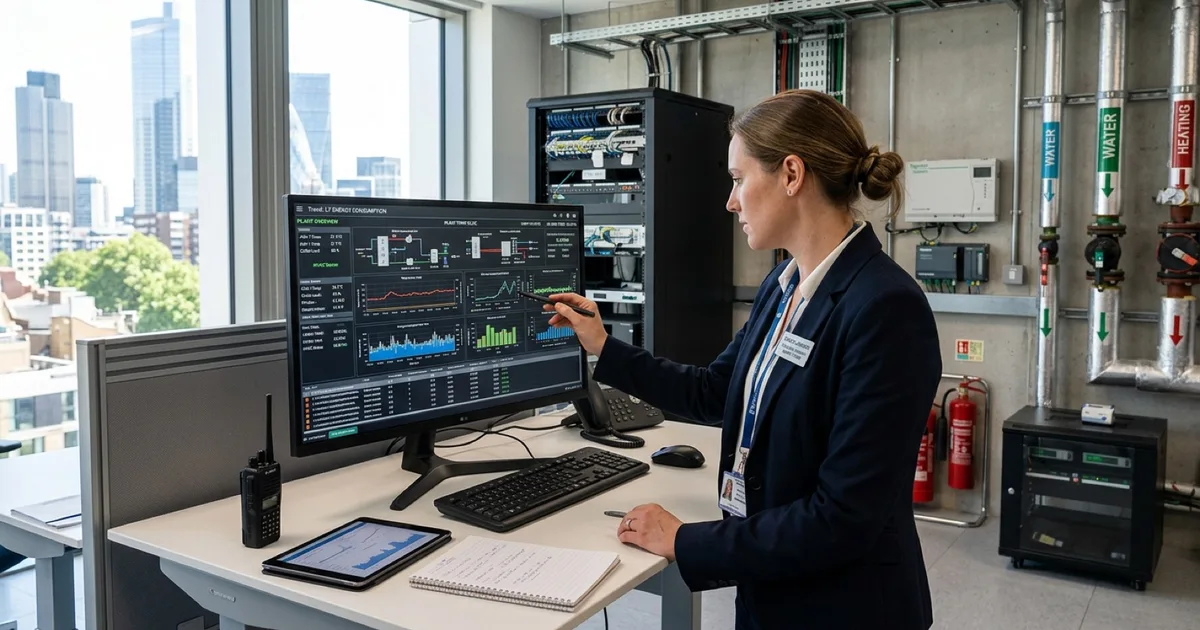
UK businesses collectively waste an estimated £2.8 billion in energy each year through equipment running outside occupied hours, demand peaks that inflate network charges, and consumption patterns nobody has ever properly looked at. An energy management system is the tool that makes those patterns visible — and in many cases, automatically correctable.
What an EMS actually does
An energy management system is a combination of monitoring hardware, control software, and communication protocols that gives you real-time and historical visibility of energy consumption across a building or site. At its most basic, it logs consumption from your electricity and gas meters at 15 or 30-minute intervals and presents that data in a dashboard. At its most capable, it integrates with your HVAC, lighting, compressed air, and production equipment — controlling setpoints, scheduling start/stop times, and alerting you when consumption deviates from expected patterns.
The distinction matters. A data logger shows you what happened. An EMS with building controls integration lets you act on what’s happening, and automate the response.
The protocols underneath it
Most commercial EMS platforms communicate with building systems via BACnet, Modbus, or M-Bus — the standard communication protocols for building automation equipment. If your HVAC, BMS (building management system), or manufacturing plant already uses these protocols, integration is straightforward. If your site runs older or proprietary systems, the integration cost rises and the business case narrows.
Cloud-based EMS platforms — increasingly the norm for SMEs — collect data via a site gateway device and present analytics via a browser or app. This removes the need for on-site server infrastructure and typically reduces the upfront cost to a hardware installation plus a monthly software licence. For businesses with multiple sites, the cloud model is usually the only practical option.
The consumption reduction case
Properly configured EMS deployments typically deliver 10–15% reduction in energy consumption without capital expenditure on new plant or equipment. The savings come from three sources: eliminating out-of-hours baseload (equipment left running when the building is empty), optimising HVAC schedules to match actual occupancy rather than assumed occupancy, and identifying demand peaks that can be flattened by adjusting start times or staggering equipment switching.
The payback period depends on your energy spend. At a site spending £80,000 a year on energy, a 12% consumption reduction saves £9,600 annually. A typical EMS installation and two-year licence in that scenario costs £6,000–10,000 — payback of 12–24 months, with ongoing savings thereafter. Below £30,000 annual spend, the case becomes tighter and more site-specific. Above £100,000, an EMS is almost always justified.
The ISO 50001 connection
If your business is working towards ISO 50001 certification — or is subject to ESOS (Energy Savings Opportunity Scheme) — an EMS is the operational backbone of compliance. ISO 50001 requires you to establish energy performance indicators, set baselines, and demonstrate continual improvement. An EMS provides the measurement infrastructure that makes this possible without manual meter reading and spreadsheet analysis.
ESOS Phase 3 compliance is due by December 2027 for qualifying organisations (broadly: 250+ employees or £44m+ turnover). If you’re in scope, starting the monitoring infrastructure now means two years of consumption data available when you need it.
What an EMS won’t fix
An EMS makes consumption visible and controllable. It won’t fix a procurement problem. If you’re buying energy at an uncompetitive rate — out of contract, on a rolled-over tariff, or on an all-inclusive contract priced against an outdated profile — the EMS savings run on top of an already inflated unit cost.
The correct sequence is: get the procurement right first, so every kWh you save is valued at the best available rate. Then implement the EMS to systematically reduce the volume of kWh consumed. Both together deliver the maximum financial impact.
Is an EMS right for your business?
The trigger points that make EMS investment most clearly justified: annual energy spend above £50,000; multiple buildings or a complex single site with varied occupancy patterns; ESOS or ISO 50001 obligations; significant process loads (refrigeration, compressed air, HVAC) running on fixed schedules rather than demand-responsive ones; no current visibility of sub-meter or half-hourly consumption data.
If you’re not sure where your energy goes, you’re not managing it — you’re just paying for it.
Telnergy works with UK businesses on both sides of this: procurement that ensures you’re buying energy competitively, and independent advice on whether the efficiency investment case stacks up for your site.
📱 WhatsApp: 07360 272168 | 📧 hello@telnergy.com | 📞 01202 028888 Telnergy Limited · Independent commercial energy consultancy since 2002 · Ofgem-aligned consultancy · ADR Ref E3561 · CRN 04576876 · Christchurch, Dorset
FAQ
What’s the difference between a BMS and an EMS?
A building management system (BMS) controls building plant — HVAC, lighting, access. An energy management system monitors and analyses energy consumption, often integrating with the BMS to optimise its operation. Some platforms combine both functions; many sites have a BMS already and add an EMS layer on top for the analytics capability.
Can an EMS integrate with solar or battery storage?
Yes — most modern EMS platforms integrate with on-site generation and storage assets to optimise self-consumption. The EMS coordinates when to store generation, when to export, and when to draw from the grid based on current tariff pricing and demand patterns.
How long does EMS installation take?
For a straightforward single-site cloud-based installation — gateway device plus connection to main meters — typically one to two days on site, with the software configuration taking a further week. Complex integrations with existing BMS or manufacturing plant take longer and require prior survey work to establish protocol compatibility.
Telnergy Limited is an independent commercial energy consultancy established in 2002, based in Christchurch, Dorset. Ofgem-aligned consultancy · ADR Ref E3561 · CRN 04576876.